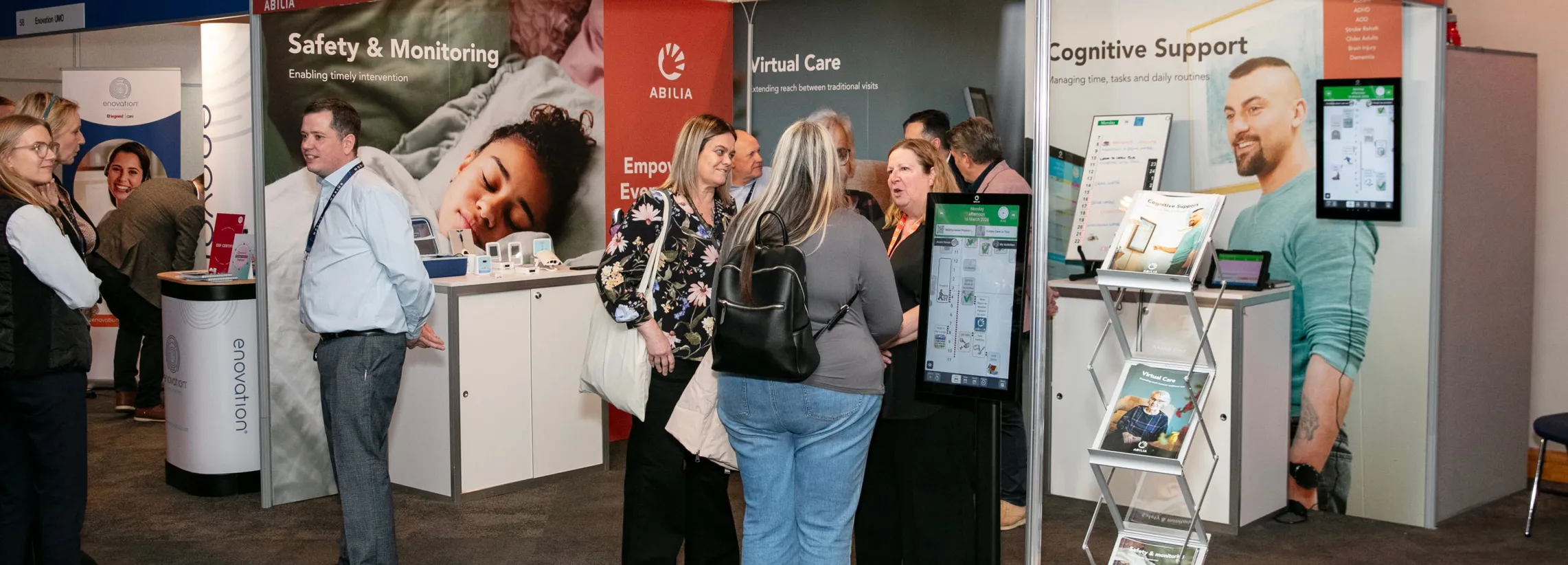
Something shifted at ITEC 2026. Not in the way that conferences sometimes promise a shift and deliver a holding pattern. This felt different. Across two days of sessions, plenaries and conversations at the ICC Birmingham, a single message came through with unusual clarity and consistency: prevention is not optional. It is not a pilot. It is not a future ambition. It is the only sustainable direction for adult social care — and technology-enabled care is central to getting there.
We came to ITEC as part of Abilia's UK team, with a stand, three portfolios and a genuine interest in how the sector is thinking. We left with a clearer sense of where things are heading and a stronger conviction that the work we are doing with Local Authorities and care providers is pointing in the right direction.
Here is what we took away.
The sector knows what it wants. The challenge is starting right.
The TEC Outlook 2026 report, launched at ITEC by TSA and PA Consulting, draws on insight from senior leaders across one in three councils in the UK. The numbers are striking. 96% of Adult Social Care leaders say their organisation would rethink care delivery if TEC could enable prevention. 78% want to move faster. Yet only 19% say their workforce has a strong understanding of TEC's role — a figure that has barely moved in three years.
Phil Holmes, Vice President of ADASS, put it plainly in the opening plenary. Projects don't fail, he said. They don't start right. That line resonated with many in the room because it names something the sector has known for a while but rarely says out loud. The technology is rarely the problem. The design, the culture, the evidence framework, the buy-in — that is where things stall.
Paul Berney of TSA, whose work on the Blueprint for Unlocking the Power of Proactive and Preventative Care Services has helped shape the sector's thinking, was equally direct. Prevention is essential, not optional. The ambition is there. The evidence is growing. What is needed now is the confidence to act on it at scale.
The financial case is becoming impossible to ignore.
Local Authorities spent a combined £29.4 billion on adult social care in 2024/25 — £2.3 billion more than the year before. ASC directors are projecting a £623 million overspend in the coming year. There were over two million requests for social care support in a single year. The maths of continuing as we are simply does not work.
What the TEC Outlook 2026 shows, and what we heard reinforced in session after session at ITEC, is that the councils making real progress are not doing anything mysterious. They are building local, defensible evidence that finance colleagues can trust. They are starting with clear outcomes rather than technology choices. And they are using that evidence to create a virtuous cycle: proof leads to investment, investment leads to scale, scale leads to more proof.
Worcestershire County Council grew the number of people served through TEC by 159% over five years using exactly this approach — co-designing a financial methodology with their own finance team from the start, so that every pound invested could be measured against every pound of cost avoided.
Surrey County Council is using analytics to identify people approaching Care Act assessment thresholds before they reach crisis — intervening earlier, at lower cost, with better outcomes.
Birmingham City Council has shown that virtual care at night, replacing intrusive and costly overnight visits, can reduce home care hours by 2 per person per week while improving independence. Their finance director is engaged because the data makes the case.
These are not pilots. These are services that have found a way to start right.
The learning disability and autism gap is an urgent and underserved opportunity.
One finding from the TEC Outlook 2026 deserves particular attention. Despite 59% of ASC leaders saying that supporting people with learning disabilities and autism is a priority, the proportion of councils regularly using TEC for this cohort has actually fallen, from 33% to 18% in a single year. The top barriers are low workforce awareness and safeguarding concerns.
This is a significant gap, and one that Baroness Tanni Grey-Thompson articulated with characteristic directness in her conference chair role. Technology-enabled care must be about enabling independence, dignity and choice. Not managing risk. Not replacing human contact. Enabling people to live the lives they want.
For people with autism, learning disabilities and early-stage dementia, cognitive support technology offers exactly this. MEMOplanner, Abilia's digital cognitive time and planning device, is designed around the Quarter Hour Watch principle — helping people understand what is happening now, what is coming next, and what they need to do. Our solutions can reduce anxiety, build routine and enable independence in daily life. The evidence base for this kind of early intervention is strong. The Darwin Care and Dorset Council case study showed over £40,000 annual cost avoidance and a staff turnover rate of 12.5% against a national average of 24.7%. For one individual, Kai, cognitive support technology avoided over £18,000 in care costs over three years while fundamentally improving his daily life and independence.
This is prevention in practice. Not a projection. A proven outcome.
Virtual care is extending reach, not replacing care.
One of the liveliest sessions at ITEC explored virtual care in practice, with Coventry City Council and Birmingham Council sharing how virtual models are being commissioned. The consistent message from commissioners was that virtual care only works when it is positioned correctly — as an extension of care between visits, not as a replacement for human support.
This is a distinction Abilia has held firmly from the beginning. Komp Pro, our virtual care delivery platform, is staff-initiated, requires no Wi-Fi, and is designed for the people most likely to be left unsupported between visits — older people, people with dementia, people living alone or going through reablement. North Lanarkshire Council achieved £55,845 annual cost avoidance by replacing costly overnight sleepover provision with Komp Pro-enabled virtual care, while improving independence outcomes for the individual supported.
One purpose across a growing portfolio.
Welcoming Alert-iT, NightWatch and Emfit into the Abilia family has strengthened what we can offer across the sector, bringing our monitoring and alarm portfolio into the same conversation as cognitive support and virtual care.
For people at risk of seizures, falls or wandering, Alert-iT, NightWatch and Emfit are designed to detect and alert to support timely awareness and response, and enabling people to live more independently at home.
Across all portfolios, the purpose is the same: enabling independence, participation and inclusion for the people we support.
What comes next.
The TEC Outlook 2026 concludes that the biggest opportunities in technology-enabled care remain untapped and that what is needed now is to turn isolated examples into shared practice. We agree. The evidence exists. The outcomes are real. The sector has the ambition.
At Abilia, we have spent over 50 years developing technology that helps people live more independently. We are not here to tell Local Authorities what prevention looks like. We are here to work alongside them, with evidence they can use, solutions they can trust, and a genuine commitment to outcomes over outputs.
What separates a good outcome from a missed opportunity is rarely the technology itself, it is the support around it. Our 6-step support framework guides Local Authorities and care providers from initial needs assessment through to meaningful outcomes — covering assessment, recommendations, data gathering, setup, training, reviewing insights, and optimisation. It is designed to ensure the right tools reach the right people, are used with confidence, and generate evidence that supports continued investment.
If you would like to explore how Abilia's portfolios could support your prevention agenda — in cognitive support, virtual care, or monitoring — we would welcome the conversation.